


On April 14, 2026, Cubework hosted an invite-only dinner on the sidelines of MODEX in Atlanta. Three speakers brought three distinct lenses — import economics, U.S. legal compliance, and warehouse technology — to an audience of logistics operators, brand owners, and supply chain leaders. Here's what each of them said.

Jack Chang, Founder, Cubeship
Jack opened with a number that reframed the conversation before it started: 35–50% margin bleed before a single unit sells. Not from competition, not from pricing — from miscalculated tariffs and duties (15–25% of landed cost), undisclosed freight fees and accessorials (10–20%), and CBP compliance delays that can kill purchase orders before a relationship even begins.
He laid out the before/after in a concrete scenario. A robotics company ships 300 units to a U.S. distributor. Wrong HTS code: 23% duty instead of 8%. Freight forwarder adds $4,200 in surprise fees. CBP hold: 3-week delay. Distributor cancels the PO. Net margin: −12% on launch.
Same shipment, right structure: correct HTS classification saves $8,400 in duties, consolidated freight cuts cost by 22%, clean documentation clears CBP in 48 hours. Net margin: +18%.
Three strategies that move the number — on shipments companies are already making:
1. HTS Reclassification. A Chinese robotics company importing components under HTS 8479.90 (25% + Section 301) that qualify as an assembled system under HTS 8479.50 (0% MFN) eliminates $62,500 in duty on a $250K shipment. Same goods. Different classification. Legal.
2. FTZ Inverted Tariff. Importing materials at 6% duty and assembling inside a Foreign Trade Zone — where the finished product qualifies at 0% — converts $60,000 in duty liability to zero on a $1M import.
3. Duty Drawback. For companies importing components and re-exporting finished goods, a manufacturing drawback claim returns 99% of duties paid. Typical annual recovery: $500K–$2.5M.
One live window worth acting on now: CBP launched the CAPE tool on April 20, 2026, allowing importers and brokers to file IEEPA duty refund claims electronically through the ACE Portal — consolidated by importer of record, not entry-by-entry. If excess duties were paid under IEEPA, this is an active recovery mechanism.
Jack closed with the line that landed hardest: "If 2025 was the year of tariff policy, 2026 is the year of enforcement." Country of Origin errors are no longer administrative issues. CBP deployed AI supply-chain mapping in 2025 specifically to detect origin washing. DOJ's Trade Fraud Task Force runs parallel criminal investigations. The numbers are real: $53M settlement, $62.5M recovery, a $400M enforcement action targeting SE Asia transshipment.

Valerie W. Ho, Shareholder, Greenberg Traurig
Valerie's practice covers trade, data privacy, and intellectual property for companies operating across borders. She structured her session around three areas where the rules have materially changed — or are being enforced in ways they weren't before.
Data Privacy
The starting point most people miss: the U.S. has no single federal privacy law equivalent to GDPR. What it has instead is 356 federal and state laws touching data privacy, and 232 touching data security — and the state-level layer is growing fast. As of 2026, 20 states — 40% of the country — have enacted comprehensive consumer privacy legislation. Three more took effect January 1 (Rhode Island, Indiana, Kentucky). More are coming.
For companies with U.S. operations, the immediate practical question is whether your home-country headquarters — particularly in China — can still access data you're collecting from U.S. users, employees, or customers. The DOJ Bulk Data Transfer Rules (Executive Order 14117) have made this a compliance line, not just a policy preference.
The rules divide transfers to "countries of concern" (China, Russia, Iran, North Korea, Cuba, Venezuela) into two categories. Prohibited transactions — including data brokerage, selling or licensing access to U.S. user data, and website pixels or app SDKs used for targeted advertising that make data accessible to covered persons — are banned outright. Restricted transactions — vendor agreements, employment arrangements, and investment relationships with covered persons — are permitted, but only under mandatory security requirements: MFA enforcement on all covered systems, data masking, comprehensive encryption, access controls, audit documentation, and CISA certification.
The practical self-check Valerie recommended: Is any HR-related data of your U.S. employees accessible by your affiliates in China or Russia? Most companies don't know the answer. That gap is where enforcement begins.
International Trade
Even as the IEEPA tariff pathway has been restricted by the courts, new tariff authorities are already in use — including Section 122 Balance of Payments surcharges of up to 15% and Section 301 USTR investigations. Greenberg Traurig's Tariff Task Force is currently helping importers on three fronts: classification, valuation, and country of origin audits to minimize duty liability; FTZ and bonded warehouse strategies for deferral and cash flow management; and active IEEPA tariff refund claims — filing protests with CBP and pursuing recovery on eligible entries.
Two supply chain compliance frameworks every importer needs to have mapped:
Intellectual Property
The core principle Valerie emphasized: IP protection is territorial. Your home-country trademark and patent registrations give you nothing in the U.S. market. File separately, and file early — before public disclosure or first sale. On copyright: registration is required to enforce in U.S. courts, and if you wait until infringement has already occurred, statutory damages and attorneys' fees are off the table.
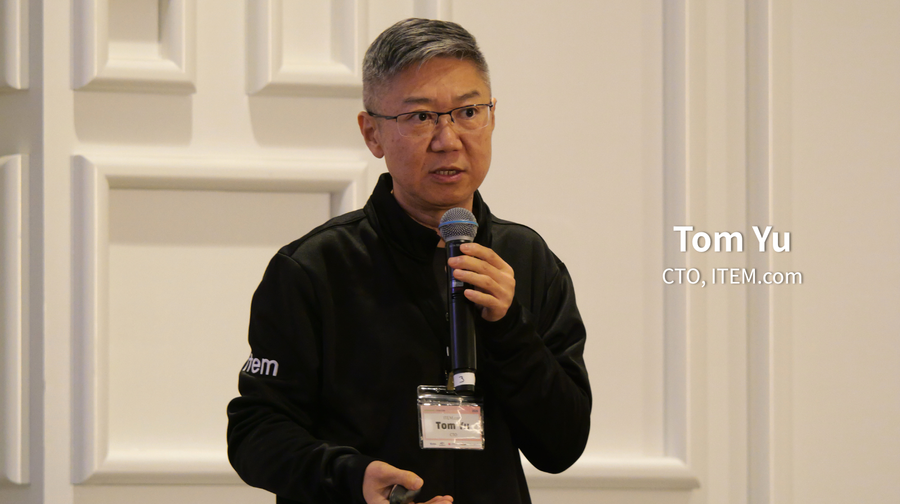
Tom Yu, ITEM
Tom's session was a ground-level look at where warehouse technology is heading — not as a roadmap, but as a description of what's already being deployed in production environments today.
ITEM's framework positions warehouse operations across three stages of maturity: digital operations (full-stack SaaS covering OMS, WMS, TMS, and YMS — eliminating data silos across the supply chain), AI-driven intelligence (agent orchestration with contextual memory and autonomous workflows — taking over the clicks-between-systems work that currently consumes human bandwidth), and warehouse automation (WES and WCS that integrate with robotics hardware and translate software logic into physical execution).
On the AI layer: ITEM has built a marketplace of agents — including an OMS/WES agent team, an AI Recruit Agent, an Agent Engine Optimizer, and an Employee Monitor Agent — designed to handle autonomous decision-making across workflows rather than surfacing information for humans to act on. The distinction matters: the goal is not better dashboards, it's fewer decisions that require a human in the loop.
On the automation side, ITEM's WES operates as an independent system that interacts with WMS and supports integration across multiple device types: AirRob autonomous mobile robots, Four-Way Shuttle systems (RCS), Bluecore AGVs, and autonomous forklifts. The system covers the full warehouse cycle — inbound (full-case and loose-piece), outbound (full-case and pick), sorting, and inventory counting. Live deployments include AMR zone picking at Lenovo, fashion warehouse storage and sort-to-store operations, and robot dog yard security monitoring.
On the e-commerce integration side, ITEM's SaaS platform connects to 168 sales channels — including Shopify, Amazon FBM, and eBay — and 80+ traditional retail channels via EDI/AS2/VAN/sFTP integrations with Walmart, Target, and Home Depot.
The through-line of Tom's session: the gap between what "warehouse technology" means in a pitch deck and what it means in a live operation is closing faster than most operators expect. The companies building that infrastructure now — in software, in AI agents, in robotics integration — are the ones setting the standard others will be measured against.
Cubework
Jack talked about the cost of getting the import structure wrong. Valerie talked about the legal exposure that compounds once you're operating in the U.S. Tom talked about the technology stack that separates efficient warehouse operations from ones that are simply busy.
What connects all three is a question none of them said out loud, but that everyone in the room was thinking: once you've got the structure right, where does the operation actually live?
That's the problem Cubework was built to solve — not for companies that have already figured out U.S. distribution, but for the ones in the middle of figuring it out. Seventy-four locations across the country's major logistics corridors. Over 16 million square feet. Five thousand businesses already operating under one roof, across every stage of market entry.
Most of the international brands that come through Cubework aren't looking for a warehouse. They're looking for a place to test whether their U.S. model works — before they sign a ten-year lease, before they hire a regional team, before they find out the hard way that the compliance gaps Valerie described are real, or that the landed cost math Jack laid out applies to them too.
The conversation that happened at Tech Night is the one that should happen before a brand commits to a U.S. market entry strategy — not after their first CBP hold, not after the first trademark dispute, not after the first quarter of margin they didn't expect to lose.
Cubework's role in this isn't to replace any of the expertise in that room. It's to be the place where all of it comes together — the physical infrastructure that makes a market entry real, and the network that makes it less lonely.
Getting US market entry right in 2026 means understanding import tariff structure before the first shipment, mapping trade compliance exposure before the first employee, and building a warehousing strategy before manual processes become the bottleneck. None of that is complicated once you know where to look. All of it is expensive when you find out too late.
Tariff structure, trade compliance, warehousing infrastructure — the rules are shifting fast, and the cost of getting it wrong shows up before your first unit sells.
We're putting together a practical guide covering everything discussed at Tech Night @ MODEX 2026: how to reduce import duty liability, what US trade compliance actually requires in 2026, and how to build a warehouse operation that scales without locking into infrastructure too early.
Leave your email to be among the first to receive it. Join the Waitlist
If you were in the room and want to continue the conversation, or if you weren't and wish you had been, reach out to Xavier Chu at xavier.chu@cubework.com.


Loading comments...